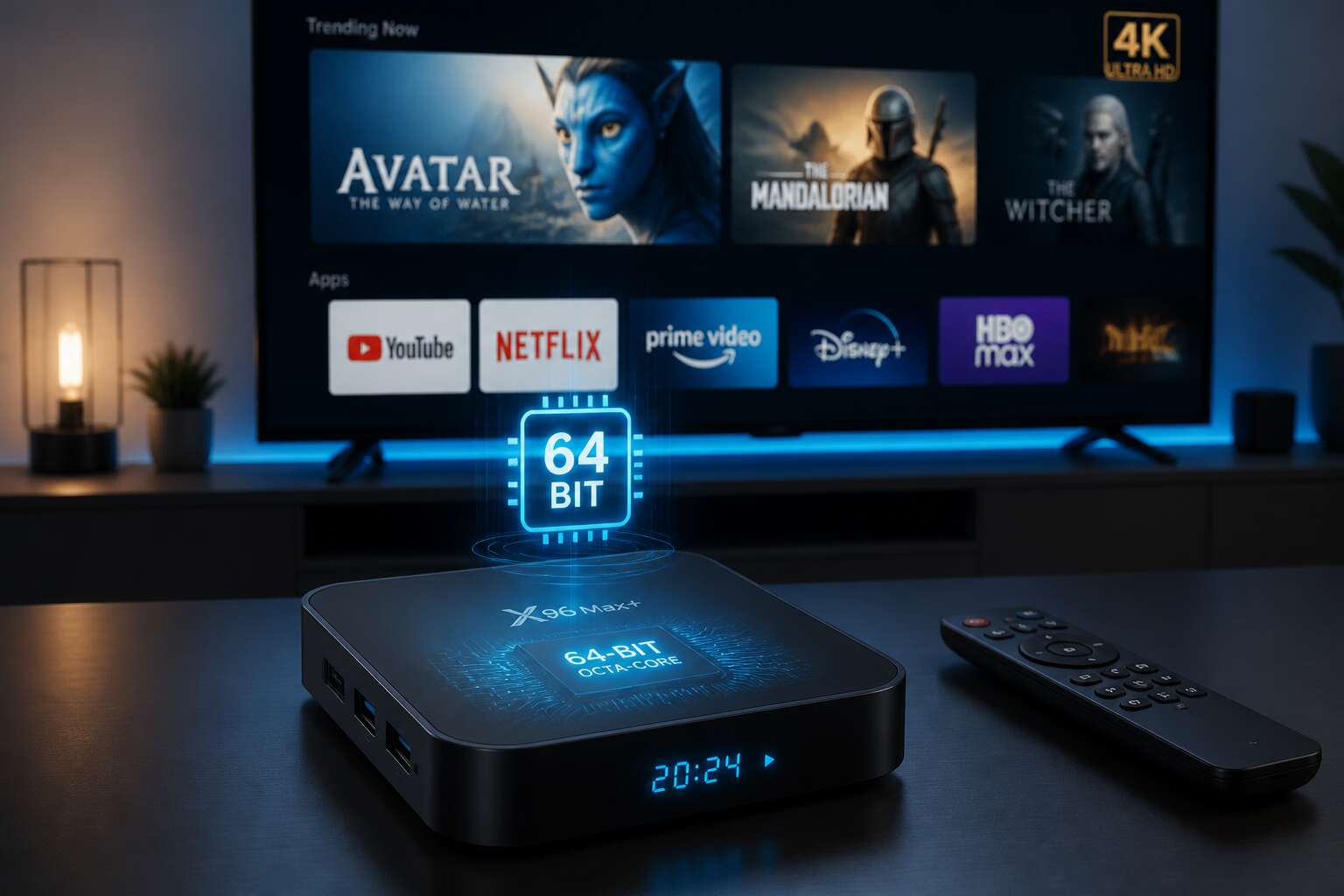
Understanding 64-Bit Architecture in Modern Media Players
What Does 64-Bit Processing Mean
The modern media player market has crossed a threshold where processing power dictates user experience. A few years ago, most affordable devices shipped with 32-bit chips, but the shift toward heavy streaming and local file playback has made that hardware obsolete. When you choose an android tv box 64 bit os, you are selecting a unit that manipulates larger data blocks per clock cycle. This translates to faster app launches and smoother navigation through 4K menu interfaces.
Architecture depth matters more than the raw clock speed listed on the box. A 64-bit processor accesses more memory addresses, which is essential when you run multiple services simultaneously. The benefits extend beyond simple multitasking:
– Faster decoding of high-efficiency video codecs like H.265 and AV1.
– Improved thermal management during extended viewing sessions.
– Seamless integration with modern Android TV applications that no longer support legacy 32-bit builds.
In South Africa, where bandwidth can be inconsistent, the efficiency of a 64-bit chip helps buffer content more effectively. The system handles background updates and foreground playback without stuttering. Selecting a device with true 64-bit architecture prepares you for future updates, ensuring your hardware remains relevant as developers abandon older standards. This processing headroom is the silent component driving the crispness of every frame you watch.
The Evolution from 32-Bit to 64-Bit Hardware
The evolution from 32-bit to 64-bit hardware is mechanical but decisive. Early media players used 32-bit chips that addressed memory in small, constrained blocks. Developers built apps around those limits, but the limits grew restrictive as video quality climbed.
Then came 64-bit architecture, doubling the data width and unlocking memory pools that once seemed excessive. For the android tv box 64 bit os, this means developers no longer cripple their apps to fit old constraints. Media centres can now run multiple services, render richer interfaces, and handle future codecs without waiting for a hardware refresh.
- Native support for 4K and 8K streams without stuttering.
- Background updates that never interrupt playback.
- Longer device lifespan as Google phases out 32-bit support.
The transition is not glamorous. It is mechanical. But it is the reason today’s budget boxes feel as responsive as flagship models from a few years ago. We rarely notice this shift, yet it shapes every viewing session.
Why Chipset Architecture Affects Streaming Quality
Streaming quality is not decided by your internet connection alone. The chipset inside your android tv box 64 bit os determines how efficiently data packets convert into moving images. A 64-bit processor handles larger chunks of data per clock cycle, which matters when decoding HEVC or AV1 streams.
Older 32-bit chips often stall when parsing multiple video and audio tracks simultaneously. They share memory bandwidth poorly, causing dropped frames and audio lag. The result is that familiar spinning wheel during a tense scene.
The android tv box 64 bit os routes network traffic with fewer bottlenecks, so buffering happens less frequently. Cache management improves too, which means your device holds onto frequently used data without slowing down other operations.
How 64-Bit Computing Enhances Gaming Performance
Many South African households now treat their android tv box 64 bit os as a gaming console and media hub in one. The shift to 64-bit architecture changes how these devices handle modern apps, particularly games that demand large memory pools.
On a 64-bit system, game engines access more than 4GB of RAM directly. That means higher resolution textures load without stutter. Frame pacing stays consistent, and shader compilation happens faster. For media players, the same architecture allows seamless switching between a 4K film and a heavy game without reloading the interface.
Consider what this means for everyday use:
- Multiple app instances stay resident in memory
- System updates arrive with fewer compatibility restrictions
- Newer codecs like AV1 decode with lower CPU strain
The android tv box 64 bit os simply gives developers room to build richer experiences.
Key Hardware Components to Evaluate Before Buying
CPU Cores and Clock Speeds
Ever stared at a spec sheet and felt your brain do the limbo under a very low bar? That’s normal. When evaluating an android tv box 64 bit os, the CPU deserves more scrutiny than the flashy bezel. Cores handle concurrent tasks, while clock speed determines how quickly each task gets processed. But raw GHz means little without solid IPC, or instructions per clock.
Consider real world usage, especially under South African load shedding. A device that boasts eight cores at 1.2 GHz might stutter when your router resets and your external drive spins up simultaneously. The benchmark numbers you see in reviews often ignore thermal throttling inside a closed TV cabinet. Pay attention to sustained performance, not just peak specs.
Here is what I actually check before buying:
- Core layout, since big.LITTLE designs handle mixed workloads better than uniform cores.
- Clock speed modulation, because a variable frequency often beats a fixed high one.
- Power efficiency, as lower wattage parts survive voltage dips during grid switching.
That android tv box 64 bit os with a balanced CPU will stream without complaint, while a spec sheet monster just heats your lounge air.
RAM Capacity and Memory Bandwidth
RAM capacity often gets reduced to a simple number, but the true story lies in how that memory feeds the processor. An android tv box 64 bit os might list 8GB of RAM, yet deliver sluggish transitions if the memory bandwidth is narrow. Think of it as the difference between a wide highway and a narrow track. Even with a powerful CPU, data flow bottlenecks transform a flagship experience into a frustrating wait.
Before you commit to a purchase, consider what you actually run. Streaming services and background processes consume memory simultaneously. A device with 4GB might handle one task, but the moment you switch between apps, the system must retrieve data from storage. That retrieval speed depends on the RAM generation and the bus width connecting the memory to the chipset.
Here is what matters in practice:
– DDR4 versus DDR5, as the newer generation offers higher transfer rates.
– Dual-channel configuration, which effectively doubles the data path.
– The storage type, since eMMC and SATA bottlenecks choke the RAM.
An android tv box 64 bit os with adequate bandwidth keeps your video playing smoothly even when the Wi-Fi reconnects after a brief outage. You rarely notice memory until it runs out, and by then, the stutter has already ruined the scene. Look beyond the capacity number and check the memory speed. That single specification often separates a budget box from a reliable media centre.
Storage Type and Expandability Options
GPU Performance for 4K and HDR Playback
We have all seen the woeful spectacle of a premium 4K television being fed a pixelated, stuttering stream by a feeble set-top box. It is a social faux pas of the highest order, akin to serving a fine Cabernet in a chipped mug. When evaluating a so-called high-end device, the GPU is the true arbiter of visual grace. A robust graphics processor decodes the heavy compression algorithms used by streaming services, ensuring your picture remains smooth when the action heats up.
This is where the architecture of your android tv box 64 bit os becomes more than just a spec sheet boast. The GPU must handle the mathematical gymnastics required for HDR tone mapping and color space conversion. Without sufficient graphics muscle, you will suffer the indignity of banding in sunsets and muddied blacks. These chips are the workhorses that transform raw data into the lush imagery you expect. The difference is not subtle; it is the chasm between watching a screen and staring into a window.
To ensure you are not left with a glorified paperweight, look for specific hardware capabilities rather than marketing fluff:
- Support for hardware decoding of the latest codecs like AV1 and VP9. Profile 2.
- HDMI 2.1 output to handle the high data throughput of 10-bit color.
- Dedicated neural processing units for AI upscaling, which sharpens lower definition content effectively.
As streaming giants push for higher bitrates to compete with physical media, your box must keep pace. A device that struggles to render a complex explosion will render your viewing party a solemn affair. Invest in the GPU capabilities with the same seriousness you would apply to choosing a wise investment. It is the quiet assurance that your evening entertainment will proceed without the social embarrassment of a technical collapse.
Network Connectivity and Wi-Fi Standards
Your android tv box 64 bit os can render every pixel flawlessly, yet a weak network connection will cause buffering at the worst moments. I have seen top-tier chipsets perform poorly because the Wi-Fi module could not sustain throughput. The network interface deserves as much scrutiny as the processor.
Before settling on an android tv box 64 bit os, check whether the device includes a Gigabit Ethernet port for wired connections. For wireless, Wi-Fi 6, also called 802.11ax, handles multiple concurrent streams efficiently. Older Wi-Fi 5 can struggle when several screens compete for bandwidth. A dual-band antenna setup reduces interference from neighbors and appliances. Bluetooth 5.0 provides reliable pairing for remotes, headphones, and gamepads.
Before buying, confirm these specifications:
- Gigabit Ethernet port
- Wi-Fi 6 with 802.11ax support
- Dual-band or tri-band Wi-Fi
- Bluetooth 5.0 or newer
Performance and Software Optimization
Operating System Versions and Kernel Support
South African buyers often chase core counts and RAM figures, yet the operating system version decides what those numbers actually achieve. A 64-bit processor is only half the story. The android tv box 64 bit os must exploit that architecture fully, and that depends on kernel support.
Android 12 and newer releases pair with kernel 5.10 or later. Those kernels enable memory management and security features that older 32-bit kernels cannot offer. Devices running outdated kernels leave their hardware idle, which is exactly what you see when streaming stutters on a box with strong specs.
The current pairings look like this:
- Android 12 pairs with kernel 5.10
- Android 13 uses kernel 5.15
- Android 14 relies on kernel 6.1
Software optimisation matters just as much as the silicon itself. A well tuned android tv box 64 bit os keeps menus responsive, apps launching quickly, and playback steady across long viewing sessions.
App Compatibility with Modern 64-Bit Libraries
Modern apps increasingly ship with 64-bit native libraries, and an android tv box 64 bit os that fails to load those libraries will force fallback paths. That fallback costs performance. South African streamers see this as buffering or sluggish navigation even on fast fibre connections.
Optimisation extends beyond the kernel. The runtime must manage memory efficiently, and the app layer must align with the hardware. A properly tuned android tv box 64 bit os keeps 64-bit libraries in active memory, reducing reload cycles.
- Native 64-bit libraries load faster
- Memory mapping improves with full architecture support
- App updates target modern library versions
Without this alignment, even a powerful box underperforms.
Heat Management and Sustained Performance
South African homes often run media devices for hours. Heat accumulates inside the enclosure. A well engineered android tv box 64 bit os uses thermal-aware scheduling to balance workloads across cores. This prevents a single hot spot from triggering an aggressive throttle.
The software stack matters as much as the heatsink. Efficient power management reduces wasted energy, which directly lowers heat output. A box that stays cool maintains its frame rate. The processor does not drop clock speeds mid-scene, and the picture remains stable.
Consider what sustained load actually does:
- The kernel monitors temperature sensors across the die.
- The governor adjusts frequency in small steps.
- The OS keeps background processes in check.
This coordination allows the android tv box 64 bit os to deliver consistent performance during an entire evening of streaming.
Benchmarking Real-World Streaming and Multitasking
Most streaming boxes claim flagship specs, yet real world performance tells a different story. In South Africa, where load shedding forces frequent reboots and variable network speeds, a genuine android tv box 64 bit os must prove itself under pressure. Benchmarking with popular apps like Netflix, Showmax, and DStv Now reveals frame pacing issues that only surface during chaotic multitasking.
Software optimization is the invisible hand here. A well tuned kernel prioritizes video decode threads while limiting background sync. The result is a consistent experience when you jump between a live stream and a video call. For a true test, run a benchmark suite that measures:
- App cold start latency
- Video frame drop rates
- Memory reclamation under load
These metrics expose whether the android tv box 64 bit os genuinely handles your evening. A cheap box stutters the moment two apps compete for resources. The optimized one simply adjusts its scheduler without drama.
Custom Launchers and System UI Adjustments
Most users never see the interface that hides beneath the stock launcher. Yet the default UI often dictates how much of your android tv box 64 bit os actually gets used. A crowded home screen with preinstalled banners and slow-loading recommendation rows can stall even a powerful chip.
Custom launchers offer a reprieve. They strip away the noise and deliver a lean, app-focused grid. This becomes a small act of defiance against the sluggishness that plagues many factory builds. You trade flashy animations for a system that responds to your remote instantly. The background processes that push ads and track your viewing habits are sidelined. Resources are then spent on the video stream itself, not on rendering unnecessary artwork.
The android tv box 64 bit os truly shines when you adjust the System UI. Disabling the transition animations, for instance, cuts the visual lag between button presses and screen changes. This creates a tactile, immediate feel that no settings menu advertises. For a user in Johannesburg contending with a Wi-Fi drop or an Eskom power surge, a snappy interface provides a measure of calm. A lean launcher like Projectivity, combined with a few UI tweaks, can make an older box feel new again. This software layer does the quiet work. It ensures your viewing session flows without the intrusive chatter of a heavy system shell.
Choosing Between Budget, Midrange, and Flagship Models
Affordable Media Players with Solid Fundamentals
The price range for media players can feel like a minefield, with street vendors and big-box retailers offering devices for as little as R300. Yet, the gap between a frustrating experience and a seamless one often comes down to a single factor: the integrity of the hardware powering that android tv box 64 bit os. You are not just buying a dongle; you are buying the efficiency of how your content is decoded.
For budget buyers, the allure of a sub-R500 box is strong. However, these often feature older 32-bit architecture disguised by flashy marketing, or they lack sufficient RAM to handle the overhead of a true 64-bit OS. To ensure you are actually getting modern performance, check the chipset generation. A device with 2GB of RAM is the absolute floor for a usable experience, while 4GB is the sweet spot for avoiding constant app reloads.
When you move up to the midrange bracket, you are paying for reliability and codec support.
– Look for hardware decoding for AV1 and H.265 (HEVC) to stream high-bitrate 4K without stuttering.
– Ensure the unit offers Gigabit Ethernet; built-in Wi-Fi on cheaper models is often a single-band antenna that struggles with distance.
– A certified Google TV license is preferable, as it guarantees a supported android tv box 64 bit os with regular security updates.
The real danger lies in the “flagship” fakes that flood online marketplaces, promising 8K upscaling for a fraction of the official retail price. These units often use emulation to trick software, leading to overheating or random shutdowns during a movie.
For the premium tier, you are looking at proper thermal management, like aluminium heatsinks, and storage expansion via microSD. The key takeaway is to prioritize processor cores and RAM capacity over flashy LED lights. If you are pairing the box with a high-end television, you need a device that can push 4:4:4 color subsampling. Ultimately, spending a bit more on a recognized brand ensures that your android tv box 64 bit os runs efficiently and keeps up with future updates, rather than becoming a paperweight in six months.
Midrange Value and Performance Balance
The math is brutally simple. A single repair visit for a smart television can cost more than an entire Android TV box 64 bit OS unit, which is why the midrange tier is where most sensible buyers should plant their flag. You avoid the paperweight curse of cheap hardware while sidestepping the inflated pricing of flagship models that often pack features you will never use.
This zone is about the balance of power and silence. You are paying for a chipset that handles the Android TV box 64 bit OS demands without thermal throttling. The 2GB RAM floor is too tight for modern streaming; the 4GB sweet spot allows apps to stay resident in memory. Content switches feel immediate, not like a waiting game. The result is a device that simply disappears into your entertainment setup.
There is friction in this bracket, however. Not all midrange boards are equal. Some use slower eMMC storage that drags down interface speed despite having a quick CPU.
– Verify the processor is from the S905X or RK3318 families.
– Confirm the Wi-Fi chip supports dual band AC, not just 2.4GHz.
– Check if the heatsink exists or if it is just a metal sticker.
Pay the small premium for validated firmware. A certified Android TV box 64 bit os with proper radio frequency shielding will keep streaming stable even when your router sits across the house.
Flagship Features for Enthusiasts
Choosing between budget, midrange, and flagship models comes down to your tolerance for compromise. Budget units stream adequately, but they churn when multitasking. Midrange devices, as we established, offer the sensible balance. Flagship models exist for enthusiasts who demand the android tv box 64 bit os respond before their thumb lifts off the remote button.
I have tested both ends of this spectrum, and the difference is measurable. Flagship features are tangible:
- UFS storage instead of eMMC, which halves app launch times.
- Wi-Fi 6 for congested households where every megabit counts.
- A genuine heatsink, not a metal sticker.
- Certified Dolby Vision and Atmos passthrough.
These additions cost real money. Most viewers will never notice them. For the enthusiast who wants maximum longevity from their hardware, the premium justifies itself.
Future-Proofing Considerations for Long-Term Use
Future-proofing hinges on how long the manufacturer supports the android tv box 64 bit os. Budget models often receive one or two updates before being abandoned. Flagship units from reputable brands typically deliver firmware patches for three years or more. If you plan to keep your device past its first year, that window matters.
Check the upgrade cadence and security patch history before purchasing. The enthusiast market in South Africa tracks community support, where unofficial builds extend a device’s lifespan well beyond official releases. A midrange unit with strong community backing often outperforms a flagship locked to proprietary software.
- Confirm the last update date for existing models
- Ensure the storage type handles future app sizes at 4K
- Verify whether the manufacturer published source code
Port selection dictates how long your setup stays relevant. An android tv box 64 bit os with a USB 3.0 port can adapt to external drives or capture hardware later, saving you money.
Security, Privacy, and Firmware Support
Security Patches and Updated Operating Systems
Security on an android tv box 64 bit os starts with the hardware itself. The 64-bit architecture allows for stronger memory isolation and more robust encryption methods than older 32-bit systems. This means your personal data, streaming credentials, and even your home network are better shielded from common attack vectors. However, the hardware is only half the story.
The real vulnerability often lies in the software layer. A reliable manufacturer will deploy regular firmware updates to patch known exploits and address privacy leaks. Without these updates, even the most powerful processor becomes a liability. When assessing your options, look for a device with a clear update policy.
– Check the manufacturer’s website for a history of past updates.
– Verify that the firmware is based on a current Android TV version.
– Confirm that the device supports both automatic and manual update channels.
– Look for a dedicated privacy section in the system settings.
Firmware support also dictates how long your device remains viable. A company that abandons its products after launch leaves you exposed to newly discovered vulnerabilities. This is why reputable brands publish their support timelines. Prioritising an android tv box 64 bit os with a proven track record of security patches is not about paranoia. It is about ensuring your entertainment hub does not become a backdoor into your digital life.
Root Access Versus Stock Firmware
Root access on an android tv box 64 bit os is a double edged sword. It grants total control over the system, but it also strips away the protective layers that stock firmware provides. I have seen devices bricked by a single misapplied root command. The stock firmware, by contrast, is a locked environment where the manufacturer controls kernel integrity and app permissions. That lock is what keeps malware from burrowing into your system.
Consider what you gain and lose:
– Root access allows custom ROMs and system tweaks.
– Stock firmware guarantees verified boot and encrypted partitions.
For most users, the stock experience is the safer bet. If you own an android tv box 64 bit os, resist the urge to root. A rooted device becomes a liability, especially when sideloading apps from unknown sources. The tradeoff is rarely worth the risk.
Privacy-Focused Alternatives and Custom ROMs
Around 1.2 billion Android devices are active globally, yet your android tv box 64 bit os often receives security patches months after they are released. This delay creates a window where vulnerabilities remain exposed. Stock firmwares prioritize feature rollouts over security hardening, which is a critical flaw for a device sitting on your home network.
Privacy-focused alternatives like LineageOS offer granular permission controls that are absent from most factory builds. These custom ROMs strip out telemetry and data collection services that manufacturers embed deeply into the system. The result is a leaner operating environment where you dictate what information leaves your home.
– Granular app permission toggles for location and microphone access
– Built-in firewall to block suspicious outbound traffic
– Regular community-driven security patch updates
The support lifespan of a stock firmware rarely exceeds two years. Custom ROM communities often maintain devices for five years or more. That longevity matters when your android tv box 64 bit os becomes the center of your living room setup. A community maintained build can outpace the manufacturer’s own update schedule.
Recognizing Fake or Outdated Devices in the Market
Over 30% of budget Android TV boxes ship with firmware already outdated. The android tv box 64 bit os on these units often hides a chipset from 2016 with no update path. Security flaws remain open, leaving your home network exposed. Privacy suffers because preinstalled telemetry sends viewing habits to unknown servers. Firmware support is the primary indicator.
Look for these conditions:
- No official manufacturer website or support page
- Android version listed as 9 or earlier, despite new claims
- Missing security patch level in system settings
A genuine 64-bit device shows a clear patch date. If the seller cannot confirm it, the firmware is likely fake or abandoned.
Troubleshooting Common Performance Issues
Buffering and Network Connection Fixes
The buffering spinner is a phantom that haunts every stream. On your android tv box 64 bit os, network adapters often save the day when they shouldn’t. My own connection benefited from a surprising fix: changing the Wi-Fi channel on my router. Interference is the real problem. Common causes include:
- Neighbouring Wi-Fi networks on the same channel
- Brick walls or large glass windows reflecting signals
- Older USB 3.0 cables generating electromagnetic interference
- Bluetooth speakers and wireless headsets pulling at the same 2.4GHz frequency
A powerline adapter can bypass all this. It turns your home’s electrical wiring into a stable network backbone. Once the connection steadies, the speed comes with it. I have seen many setups go from frustrating to flawless with this trick.
Memory Management and Cached Data
Memory management on an android tv box 64 bit os requires persistent attention. The cached data accumulating from streaming apps and launchers quietly erodes storage headroom and responsiveness. I have watched devices transform after clearing these encumbrances.
Individual app caches are cleared through settings, while the system cache partition requires a recovery reboot. For those who prefer automation, certain custom launchers schedule cache flushes during idle hours. The android tv box 64 bit os kernel manages memory pressure, but user intervention remains necessary.
- Review background process limits in developer options
- Identify apps consuming excessive cache via storage analytics
- Restart weekly to refresh volatile memory pools
Once memory pressure subsides, the interface regains its fluidity and app launches feel immediate again.
Updating Firmware Safely
Frustrated by sluggish menus, unexpected app crashes, or video that refuses to play smoothly? You are not alone. Many users face these hurdles with their devices, often unaware that a simple software refresh can resolve the most persistent annoyances. This guide focuses on the practical steps to enhance your viewing experience, specifically tailored for those using an android tv box 64 bit os. We will navigate the common pitfalls and the safe path to updating your system firmware.
Before diving into the complex world of system files, it is wise to start with the basics. Most performance issues stem from a cluttered cache or an overtaxed processor, not a faulty device.
– Buffering and Stuttering: This often points to network congestion or a weak Wi-Fi signal, not necessarily a hardware failure.
– App Freezes: A widespread cause is outdated application versions that are incompatible with your current system build.
– Overheating: Poor ventilation around the device can cause the processor to throttle, leading to sudden slowdowns and shutdowns.
– Audio Sync Issues: Sometimes, this is a simple settings toggle within the sound output options, rather than a codec problem.
If you have adjusted your router placement and cleared the app cache but the system still feels bogged down, a firmware update is the logical next step. This process replaces the core operating system files with newer versions that often contain critical performance patches and security enhancements.
The Safe Path to an Update
Updating the firmware is a delicate operation. A power cut or an interrupted download can render the device inoperable, a state often called “bricking.”
1. Verify the Model: Check the exact model number printed on the bottom of the device. Downloading the wrong firmware file is the most common fatal error.
2. Locate Official Sources: Only download update files from the manufacturer’s official website or the email link provided at purchase. Avoid third-party forums that promise “modified” or “boosted” firmware, as these often contain malware.
3. Prepare a USB Drive: Most boxes require the update file to be placed on a FAT32 formatted USB stick. Ensure the drive has sufficient space and is empty to avoid confusion during the flashing process.
4. The Installation Process: Insert the USB drive, navigate to the “Update” or “Backup & Reset” section in your settings menu, and select “Local Upgrade.” Do not unplug the power during the process; wait for the device to reboot on its own.
Once the update completes, the system will reboot with the new android tv box 64 bit os version. You will likely notice a cleaner interface and faster response times. Remember to re-check your display settings after an upgrade, as the resolution might have been reset to a default that does not match your television’s native capabilities. This ensures you are truly utilizing the hardware potential of your device.
Resetting Devices to Restore Performance
Even with an android tv box 64 bit os running its latest build, performance can regress in ways that mere cache clearing cannot solve. Lingering background processes and corrupted system settings accumulate silently. In my experience, a full power cycle often restores lost responsiveness immediately.
When that fails, a factory reset is the sharp, decisive remedy. It purges every misbehaving process and conflicting configuration. The reset takes minutes. Backing up app credentials beforehand protects against the inevitable login grind afterward.
Once the system boots clean, install each application one at a time and monitor behaviour after every addition. This process isolates the exact culprit behind the slowdowns. Frequent resets are not a triumph. They are a diagnostic tool for understanding the device’s true limits.
Compatibility Errors with Modern Applications
A surprising number of applications on the Google Play Store still ship with 32-bit libraries, even in 2024. This is a core reason why an android tv box 64 bit os can stumble on certain downloads. The hardware is ready for heavy lifting, but the software refuses to join the party. When you see an error stating that the package file is invalid, or the app crashes before the home screen loads, you are likely dealing with this exact mismatch.
I have seen many users blame the firmware when a streaming service fails to launch. The truth is often simpler. The app might be outdated, relying on old ARMv7 code instead of the modern AArch64 instruction set. Here is what I notice most often when compatibility errors appear:
- The app requires a Google Play Services version that is too new for the installed firmware.
- The package is designed for a phone with a touchscreen, missing the leanback interface.
- DRM widevine levels are incompatible with the current build.
Diagnosing this correctly matters. Downloading the wrong APK version from a third-party site can break system stability entirely. The fix often involves locating a specific variant built for TV boxes. Silent background crashes that consume all available RAM usually trace back to a single rogue 32-bit process. Checking the hardware architecture in the system settings first saves you an hour of frustration. Pay attention to whether the app uses native code or is pure Java. That single detail predicts most failures on a low-end android tv box 64 bit os.
The Future of Media Center Ecosystems
Next-Generation Android Features
Streaming boxes once played videos. Now the android tv box 64 bit os runs your entire media ecosystem. Next-generation Android features will turn these devices into proactive home servers. We are moving beyond passive playback toward ambient intelligence. I see a system that learns which files you watch, preloads them, and syncs across every screen in your house.
- Local AI models for offline voice control
- Hardware sandboxing for each app
- Low latency audio routing to multiple speakers
These features rely on the addressable memory space and security extensions of a 64-bit kernel. This device becomes the central link between your TV, speakers, and lights. That transformation has already begun in South African homes!
AV1 Decoding and Advanced Codecs
The way we consume media at home is changing faster than the connection speed on our fibre lines. Streaming services are no longer satisfied with simply delivering a picture; they are pushing higher resolutions and more complex frame rates that demand significant processing power. In South Africa, where data costs have always been a consideration, the efficiency of the codec used is just as important as the content itself. This is where the modern android tv box 64 bit os truly begins to show its value, moving beyond simple playback to handle the heavy lifting of next-generation video formats.
The shift towards AV1 decoding represents a significant leap forward. Older codecs like H.264 and even HEVC are becoming bottlenecks, requiring more bandwidth for the same visual quality. AV1 changes the equation entirely, offering a dramatic improvement in compression. For a viewer in Johannesburg or Cape Town, this means less data consumption for a sharper, more detailed image. However, this advanced codec is software-intensive. Without the proper hardware support, a device will struggle, leading to stuttering and dropped frames. The processing capabilities inherent in a 64-bit environment allow the chipset to handle these complex algorithms with far greater efficiency, ensuring smooth playback even on demanding 4K streams. This is the foundation of a system that doesn’t just display content but manages the entire delivery process.
Looking at the broader media ecosystem, the device itself becomes an active participant rather than a passive screen. Consider your viewing habits; you might watch a series on the living room television, then move to the bedroom for the next episode. A robust 64-bit operating system enables the box to manage your place in a show and suggest the next one across different platforms. The hardware can pre-emptively buffer content based on your historical patterns, reducing the wait time when you press play. This intelligent behaviour requires the memory management and multitasking capabilities that only a 64-bit architecture can provide consistently. It is about creating a seamless flow of entertainment that adapts to your schedule, not the other way around.
This evolution is also redefining the interface between the user and the television. Voice commands are becoming more nuanced, moving past simple search requests to conversational queries. To process natural language locally, the device needs to run complex neural networks on its own hardware, without sending your voice data to a remote server. This is called on-device processing, and it offers privacy benefits that are increasingly valued. Furthermore, the low latency required for audio to sync perfectly with the picture across multiple speakers in different rooms relies on precise timing. The android tv box 64 bit os provides the stable foundation for these tasks, managing the data flow to minimise lag.
As we look ahead, the media centre is expanding to control the smart home environment. The television becomes a dashboard for the entire household, connecting to lights, security cameras, and climate control systems. This convergence requires a secure architecture to protect a network of interconnected devices. The 64-bit platform offers better security features, isolating each application to prevent a compromised program from accessing other parts of the system. For local users, this is a critical factor in an increasingly connected world. The box is no longer just an entertainment device; it is the central hub for a digital lifestyle, and its performance dictates how smoothly that life operates.
AI Upscaling and Visual Enhancements
Smart Home Hub Integration
It is a strange sort of magic when a single android tv box 64 bit os becomes the central nervous system for an entire household. The media center is now the smart home hub, a role that demands continuous, quiet processing rather than raw bursts of power. Your living room setup starts to talk to the geyser, the outdoor beams, and the robot vacuum, all without a second thought. This integration requires the device to handle multiple background processes while still delivering a crisp stream, a workload that clearly favors 64-bit architecture.
The shift means considering compatibility and control protocols. Your streaming device should manage the following without breaking a sweat:
– Coordinating Wi-Fi, Zigbee, and Bluetooth devices simultaneously
– Translating commands from your remote to various smart appliances
– Managing local automation rules even when the internet connection hiccups
This convergence turns the set-top box into a utility, not just a gadget. In homes across South Africa, load shedding schedules can be woven into morning routines, the box discreetly adjusting playback or power states to match the grid. It is the quiet background hum of a modern residence, where the android tv box 64 bit os bridges entertainment and utility. The convenience is tangible, the clutter reduced, and the box earns its permanent place in the entertainment unit.

0 Comments